
12 High-Demand, Low-Competition SaaS? Niches (2026)
Compare 12 high-demand, low-competition SaaS? niches for 2026, ranked by recurring demand signals, source coverage, and incumbent gaps. Current examples include AI Search Citation Tracker for SEO? Teams, On-Call Scam Verification Desk for Small Businesses, Social Profile Conversion Sprint for Owner-Led Businesses.
14 min read
Introduction
Updated August 6, 2026: The 12 niches below are ranked from a same-day Trend Seeker snapshot. We compared recurring demand, independent source coverage, the number of adjacent products our enrichment pipeline could map, and the size of the workflow gap. The result is a shortlist to investigate, not a claim that any market has no competitors.
Most lists of high-demand, low-competition SaaS? ideas start with a product name. We start with the evidence. A niche moves up when the same operational problem appears in several source types and the mapped products are adjacent rather than direct. It moves down when demand comes from one source, the buyer has no clear budget, or a horizontal incumbent already owns the workflow.
The opportunity is specific. Across 440,137 matched signals in our database, users repeatedly describe a job that still needs spreadsheets, handoffs, or several disconnected tools. That gap is more useful than a broad claim such as "accounting SaaS? is growing." For a deeper look at collection and scoring, read our methodology breakdown and evidence score guide.
How We Measure Low Competition
"Low competition" is easy to overstate. We use four checks to rank a research queue. They are screening criteria, not a statistically validated market score.
| Signal | Stronger evidence | Needs checking | Warning sign | What it tells us |
|---|---|---|---|---|
| Recurring demand | Repeated, specific workflow pain | Several variants of one request | One viral or vague mention | Whether the problem repeats |
| Source coverage | Several independent source types | One strong source type | Duplicated or contaminated rows | Whether demand is corroborated |
| Incumbent gap | Few direct products; clear missing workflow | Mostly adjacent products | Several direct, well-reviewed tools | Where a focused product could differ |
| Buyer intent | Named buyer, budget, current workaround | Prosumer or mixed buyer | Interest without a paid job | Whether demand can convert |
We excluded the noisy three-month related-query rows from this refresh. The longer five-year view supports growing interest in year-qualified SaaS?-idea searches, but search interest does not validate any individual product. The ranking below comes from product-level evidence, not from Google Trends alone.
Where Low Competition Niches Live on the Demand-Competition Map
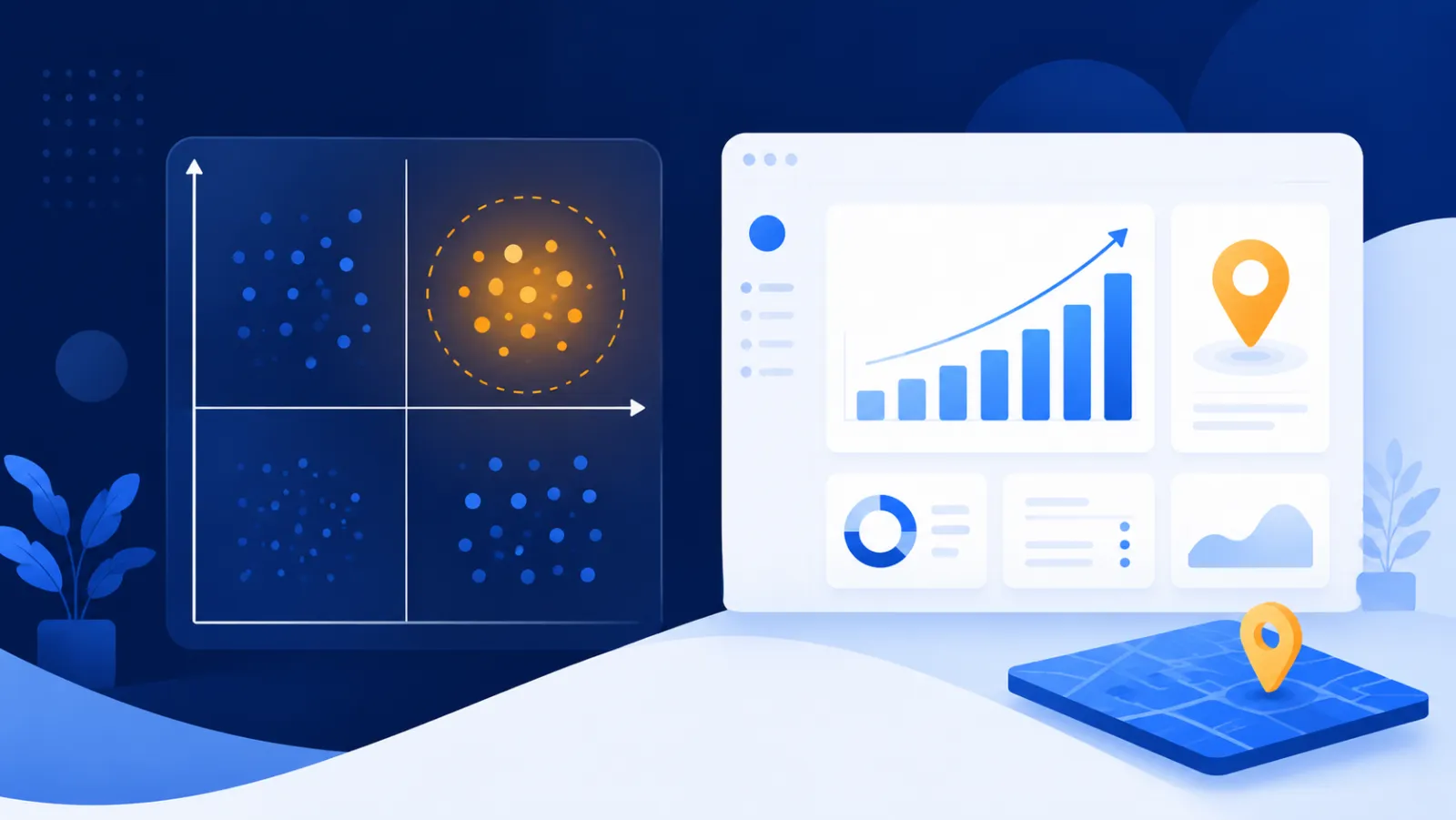
The fastest way to think about this is a simple 2x2. Demand on one axis, competition density on the other. Most "obvious" SaaS? ideas live in the top-right quadrant where everyone is fighting. The interesting work happens in the top-left.
The blue dots are where validated low competition niches typically cluster. The job is to find more of them and ship before they migrate right.
The 12 Low Competition SaaS? Niches for 2026
This table is the August 6 snapshot. "Signals" means matched evidence items attached to the idea in Trend Seeker. "Sources" means distinct source types, such as job ads, podcasts, product launches, Google Trends, or Reddit. "Mapped products" counts adjacent or competing products found by our enrichment step. It is not a complete market census.
| Rank and niche | Signals | Sources | Mapped products | Focused opening |
|---|---|---|---|---|
| 1. Missed-call recovery for service businesses | 82 | 4 | 0 mapped | Recover, qualify, and book one trade's missed leads |
| 2. SaaS? affiliate-partner matching | 50 | 4 | 0 mapped | Verified niche publishers plus attribution handoff |
| 3. Finance forecast workflow automation | 46 | 2 | 0 mapped | One repeatable forecast and variance workflow |
| 4. Technical support escalation workspace | 42 | 1 | 0 mapped | Coordinate support, success, and engineering through root cause |
| 5. Spec?-driven data pipeline builder | 31 | 1 | 0 mapped | Turn approved specs into tested, documented ELT |
| 6. RAG? pipeline quality optimizer | 30 | 2 | 0 mapped | Test chunking, retrieval, citations, and regressions together |
| 7. Usage-billing control hub | 28 | 2 | 0 mapped | Reconcile metering, invoices, and customer-visible usage |
| 8. Clinical data quality integration | 11 | 2 | 0 mapped | Validate mappings across EHR, FHIR, claims, and pharmacy data |
| 9. Chargeback prevention and direct resolution | 9 | 5 | 0 mapped | Resolve customer disputes before processor escalation |
| 10. Healthcare integration workbench | 9 | 1 | 0 mapped | Configure and validate HL7, FHIR, X12, SSO, and SFTP |
| 11. Dispatch and appointment routing | 8 | 2 | 1 mapped | Sequence stops against live appointment windows |
| 12. Payment-processor risk monitor | 7 | 4 | 3 mapped | Track payout holds, account health, and processor concentration |
The table shows why raw volume is not enough. Chargeback prevention has only nine matched signals, but they span five source types. Technical support escalation has 42 signals from one source type, so it ranks lower than its volume suggests. A zero in the mapped-products column means the automated pass found no confident match. It does not mean the market has no competitors.
1-3. Clear buyer, measurable revenue impact
Missed-call recovery ranks first because the buyer and lost-value event are both obvious. The broad AI voice-agent market is crowded, but "answer every call" is not the niche. A focused product would serve one trade, know its qualification questions, connect to its scheduler, and report booked revenue. SaaS? affiliate matching has a similar shape: do not build another affiliate network. Build a verified discovery and handoff layer for one SaaS? category where partner fit is still researched manually.
Finance forecasting is also broad. The incumbent gap is narrower: automate one planning cadence for a specific operating model, keep spreadsheet compatibility, and make assumptions and variance explanations reviewable. The smallest useful test is a concierge forecast cycle with three finance teams, not a complete FP&A platform.
4-7. Internal workflows fragmented across several tools
Support escalations, data-pipeline delivery, RAG? quality, and usage billing all sit between established systems. That is the opening and the risk. Each product needs to own a complete cross-tool workflow without pretending to replace the systems of record. For example, a support escalation workspace should preserve the path from customer report to reproduction, engineering owner, workaround, root cause, and customer follow-up.
The same rule applies to RAG? and billing. A RAG? quality product should compare retrieval changes against a fixed evaluation set and show citation regressions. A usage-billing product should make a metering discrepancy traceable from event to invoice and then expose the same explanation to the customer. These are narrow, testable jobs. "AI platform" and "billing platform" are not.
8-12. Smaller volume, stronger domain constraints
Healthcare integration, chargebacks, dispatch, and processor risk have lower signal counts but clearer operating constraints. Those constraints can protect a focused product, but they also raise the cost of validation. The official FHIR specification shows the breadth hidden behind "healthcare integration." The CMS interoperability guidance is a useful starting point for US healthcare buyers. Neither source proves demand for a product. They explain the standards a credible product must handle.
Chargeback prevention and payment-processor monitoring look related, but the buyers and moments differ. The first intervenes in a customer dispute. The second helps finance and risk teams watch payout exposure before it becomes an incident. Dispatch routing is narrower again: it needs to reconcile route efficiency with promised appointment windows, not merely draw the shortest path.
What about untapped B2C? SaaS? niches?
The query cluster includes untapped B2C? SaaS? niches, but none made this top 12. That is deliberate. Consumer requests can show strong interest and still have weak paid intent, high churn, or expensive acquisition. A verified open-source website builder appeared across four source types in the snapshot, for example, but our enrichment pass also mapped five adjacent products. It belongs in the watchlist until a sharper consumer segment and paid job emerge. Browse current SaaS opportunities or developer-tool opportunities to inspect the live evidence behind the broader queue.
What Each Niche Type Looks Like
Not all low competition niches behave the same way. Three patterns dominate. Understanding which type you are picking changes how you build, price, and market.
| Type | Example shape | Typical price | Time to MVP? | Defensibility |
|---|---|---|---|---|
| Vertical SaaS? | CRM? for one specific trade | $50-$300/mo | 8-12 weeks | High - domain depth |
| Workflow automation | Replace a spreadsheet for one task | $20-$80/mo | 4-8 weeks | Medium - integrations matter |
| Niche dev tool | Solve one CI/CD or API? pain | $15-$50/mo | 3-6 weeks | Low-medium - copyable |
Vertical SaaS? wins on retention and pricing power but takes longer to build. Niche dev tools ship fast but are easier to clone. Pick based on your build appetite and your willingness to do customer development in a specific industry.
How to Stress-Test a Niche Before Building
A name on a list is not validation. Before you write any code, run each candidate niche through this short test. The full mental model is in our lazy founder's product validation guide.
- Search the buyer query yourself - if the top three results are dedicated tools with strong reviews, the niche is not low competition no matter what a list says.
- Read 20 source posts - confirm the pain is recurring, recent (within the last 12 months), and described in similar language by different users. One viral thread is not a niche.
- Talk to five potential users - ask what they currently use and what would make them switch. If they cannot name a current solution, the demand may be weaker than it looks.
- Check willingness to pay - users complaining on a free subreddit are not the same as users with budget authority. Look for B2B? context, as covered in our startup validation guide.
- Run the idea through our free idea validator - it tests your concept against 440,137 matched market signals and returns a demand score, the closest matching requests, and existing tools in the space.
Low Competition Traps to Avoid
Most "low competition" niches are low competition for a reason that should kill the idea. Watch for these.
- Feature-inside-a-product traps - if the niche is one feature in a horizontal tool, the incumbent will copy you the moment you get traction. Vertical depth, not horizontal feature gaps, is what makes a niche defensible.
- Regulated vertical traps - some niches look open because compliance requirements scared off founders. Healthcare, finance, and legal niches often need 12+ months of certification work before you can charge.
- Hobbyist demand without budget - high demand on consumer subreddits with no B2B? context usually means strong wishlist energy and weak conversion to paid plans. Validate budget first.
- Niches where the gap is distribution, not product - sometimes a tool already exists and is excellent but invisible. If the SERP? is weak because nobody markets, building a fifth tool will not help. Buy SEO? or partnerships instead.
- Demand spikes from a single news cycle - if all the source posts cluster in one month, the demand is reactive and may not sustain a subscription business. Our Reddit complaint analysis guide covers how to separate sustained pain from spikes.
Why 2026 Is the Right Window
The timing case comes from two different signals. First, the five-year Google Trends view for year-qualified SaaS?-idea searches is rising. That supports refreshing the research now, but it does not prove any niche will sell. Second, the August 6 Trend Seeker snapshot contains current product-level evidence across job ads, podcasts, product launches, Google Trends, Reddit, and other public sources. We did not use the contaminated three-month related-query rows as evidence.
There is no universal 2026 window and no reliable rule that a founder must ship within a fixed number of days. The practical reason to act now is simpler: the source evidence is current enough to interview buyers against it. Recheck the market before each build decision because mapped competitors, regulations, and buyer priorities can change.
Where to Go Next
This page covers the framework and the traps. The continuously updated niche list, evidence scores, and source posts live in the database.
- Browse our full SaaS ideas database with demand and competition scores for every opportunity
- Read 37 micro SaaS ideas for 2026 for the broader ranked list including higher-competition opportunities
- Explore unmet needs in developer tools for technical low competition niches
- Read 20+ solopreneur business ideas for non-SaaS? opportunities a single founder can run
- Compare 7 idea validation tools we tested to pick the right validator for your niche
- See our guide to finding business ideas on Reddit for manual research techniques
- Read the best subreddits for business ideas to know where to look
- Use the free idea validator to score your niche against 440,137 matched market signals
- Follow the narrow buyer and problem terms with Trend Seeker Monitors as source alerts roll out
Sources and Further Reading
- How Trend Seeker finds business ideas - collection and clustering methodology for the source signals used in this snapshot
- Understanding evidence scores - how volume, urgency, specificity, and source context should be interpreted
- Google Trends - the five-year search-interest view used for directional corroboration; short-term related rows were excluded
- HL7 FHIR specification - primary reference for the interoperability requirements behind two healthcare niches
- CMS interoperability guidance - primary US policy context for healthcare data exchange
Subscribe to our weekly newsletter for new low competition niches as they emerge.
Ready to find your next business idea?
Explore validated business ideas backed by real user demand.
This week Trend Seeker found
+2,195ideas
and
+74,184signals

%22%20%2F%3E%0A%20%20%20%20%20%20%0A%20%20%20%20%20%20%3C!--%20Sun%20--%3E%0A%20%20%20%20%20%20%3Ccircle%20cx%3D%22244%22%20cy%3D%22104%22%20r%3D%2256%22%20fill%3D%22hsl(10%2C%2050%25%2C%2055%25)%22%20opacity%3D%220.85%22%20%2F%3E%0A%20%20%20%20%20%20%0A%20%20%20%20%20%20%3C!--%20Background%20Hill%201%20--%3E%0A%20%20%20%20%20%20%3Cpath%20d%3D%22M%200%2096%20Q%20160%2088%20400%2082%20L%20400%20160%20L%200%20160%20Z%22%20fill%3D%22hsl(25%2C%2030%25%2C%2068%25)%22%20%2F%3E%0A%20%20%20%20%20%20%0A%20%20%20%20%20%20%3C!--%20Midground%20Hill%202%20--%3E%0A%20%20%20%20%20%20%3Cpath%20d%3D%22M%200%20112%20Q%20260%2094%20400%20122%20L%20400%20160%20L%200%20160%20Z%22%20fill%3D%22hsl(20%2C%2035%25%2C%2052%25)%22%20%2F%3E%0A%20%20%20%20%20%20%0A%20%20%20%20%20%20%3C!--%20Foreground%20Hill%203%20--%3E%0A%20%20%20%20%20%20%3Cpath%20d%3D%22M%200%20128%20Q%20120%20131%20400%20137%20L%20400%20160%20L%200%20160%20Z%22%20fill%3D%22hsl(15%2C%2025%25%2C%2035%25)%22%20%2F%3E%0A%20%20%20%20%20%20%0A%20%20%20%20%20%20%3C!--%20Technical%20grid%20overlay%20removed%20for%20a%20cleaner%20organic%20look%20--%3E%0A%20%20%20%20%3C%2Fsvg%3E)
%22%20%2F%3E%0A%20%20%20%20%20%20%0A%20%20%20%20%20%20%3C!--%20Sun%20--%3E%0A%20%20%20%20%20%20%3Ccircle%20cx%3D%22294%22%20cy%3D%22104%22%20r%3D%2258%22%20fill%3D%22hsl(35%2C%2060%25%2C%2070%25)%22%20opacity%3D%220.85%22%20%2F%3E%0A%20%20%20%20%20%20%0A%20%20%20%20%20%20%3C!--%20Background%20Hill%201%20--%3E%0A%20%20%20%20%20%20%3Cpath%20d%3D%22M%200%2096%20Q%20160%2098%20400%20107%20L%20400%20160%20L%200%20160%20Z%22%20fill%3D%22hsl(85%2C%2020%25%2C%2055%25)%22%20%2F%3E%0A%20%20%20%20%20%20%0A%20%20%20%20%20%20%3C!--%20Midground%20Hill%202%20--%3E%0A%20%20%20%20%20%20%3Cpath%20d%3D%22M%200%20112%20Q%20260%20106%20400%20128%20L%20400%20160%20L%200%20160%20Z%22%20fill%3D%22hsl(100%2C%2015%25%2C%2042%25)%22%20%2F%3E%0A%20%20%20%20%20%20%0A%20%20%20%20%20%20%3C!--%20Foreground%20Hill%203%20--%3E%0A%20%20%20%20%20%20%3Cpath%20d%3D%22M%200%20128%20Q%20120%20141%20400%20147%20L%20400%20160%20L%200%20160%20Z%22%20fill%3D%22hsl(120%2C%2020%25%2C%2030%25)%22%20%2F%3E%0A%20%20%20%20%20%20%0A%20%20%20%20%20%20%3C!--%20Technical%20grid%20overlay%20removed%20for%20a%20cleaner%20organic%20look%20--%3E%0A%20%20%20%20%3C%2Fsvg%3E)