
Payment Reconciliation Business Opportunities: Why Exception Work Is the Wedge
Trend Seeker found 348 payment-gap ideas backed by 4,432 distinct signals. The practical business wedge is resolving payout, settlement, and ledger exceptions.
12 min read

Introduction
The clearest payment reconciliation business opportunity is not another generic matching dashboard. It is a focused service that owns the exceptions after routine matching stops. The work starts when a payout is short, a fee arrives net of settlement, a refund lands in a later period, a bank credit lacks a usable reference, or the ledger and processor describe the same transaction differently.
Trend Seeker's Demand Map snapshot generated August 10, 2026 contains 348 ideas in the Payment Gaps region connected to 4,432 distinct logical signals. The non-obvious pattern is operational. Companies need someone to trace a payment across systems, classify the break, assign an owner, preserve the evidence, and stop the same exception from returning.
What the Payment Gaps region shows
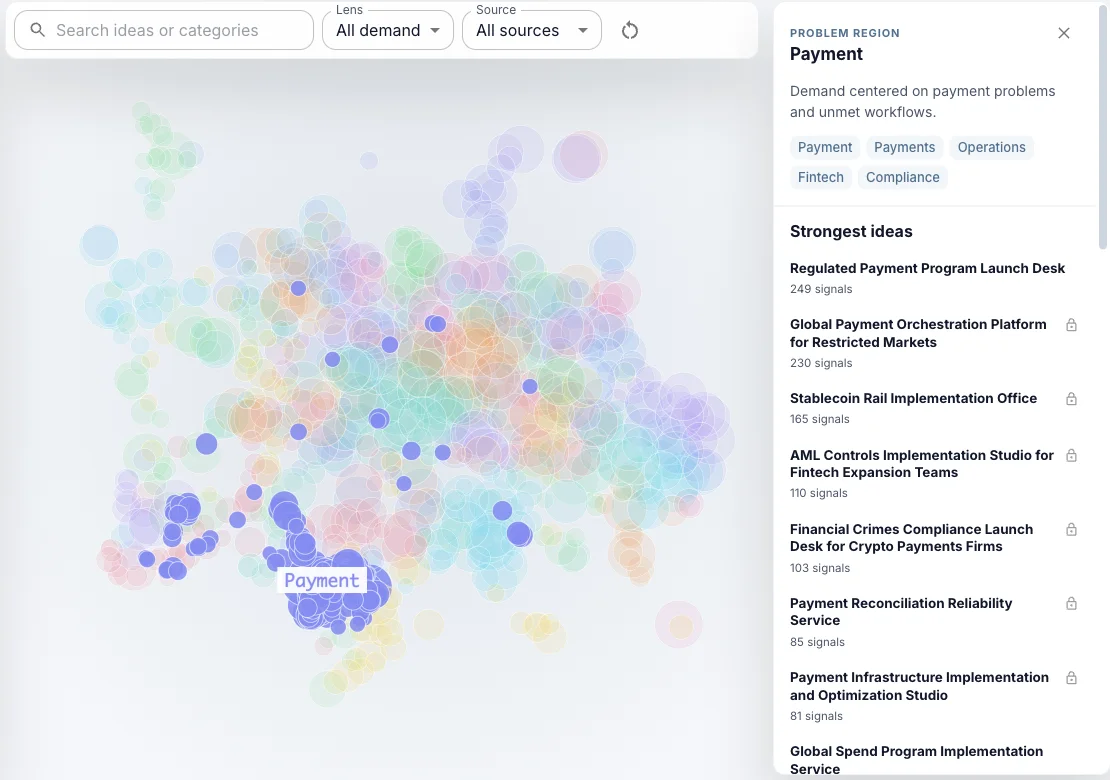
This analysis uses the complete Payment Gaps Demand Map region. It sits close to Finance, Risk, and Security because a payment break is rarely only an accounting problem. The same exception can affect cash position, customer support, fraud review, compliance evidence, or period close. The selected view below keeps Payment saturated and fades every other region so the cluster boundary and its strongest ideas are easier to inspect.
| Measure | August 10 snapshot | Definition |
|---|---|---|
| Ideas | 348 | Distinct business ideas assigned to region 10, Payment Gaps. |
| Distinct logical signals | 4,432 | Evidence deduplicated by source kind and logical signal key across the region. |
| Idea-signal matches | 4,738 | Connections between ideas and signals. One logical signal can support several ideas. |
| Distinct source URLs? | 3,173 | Unique public URLs? among the deduplicated records that include a URL?. |
| Fresh logical signals | 636 in 30 days 3,165 in 90 days | Most recently observed inside exact windows ending at the snapshot generation time. |
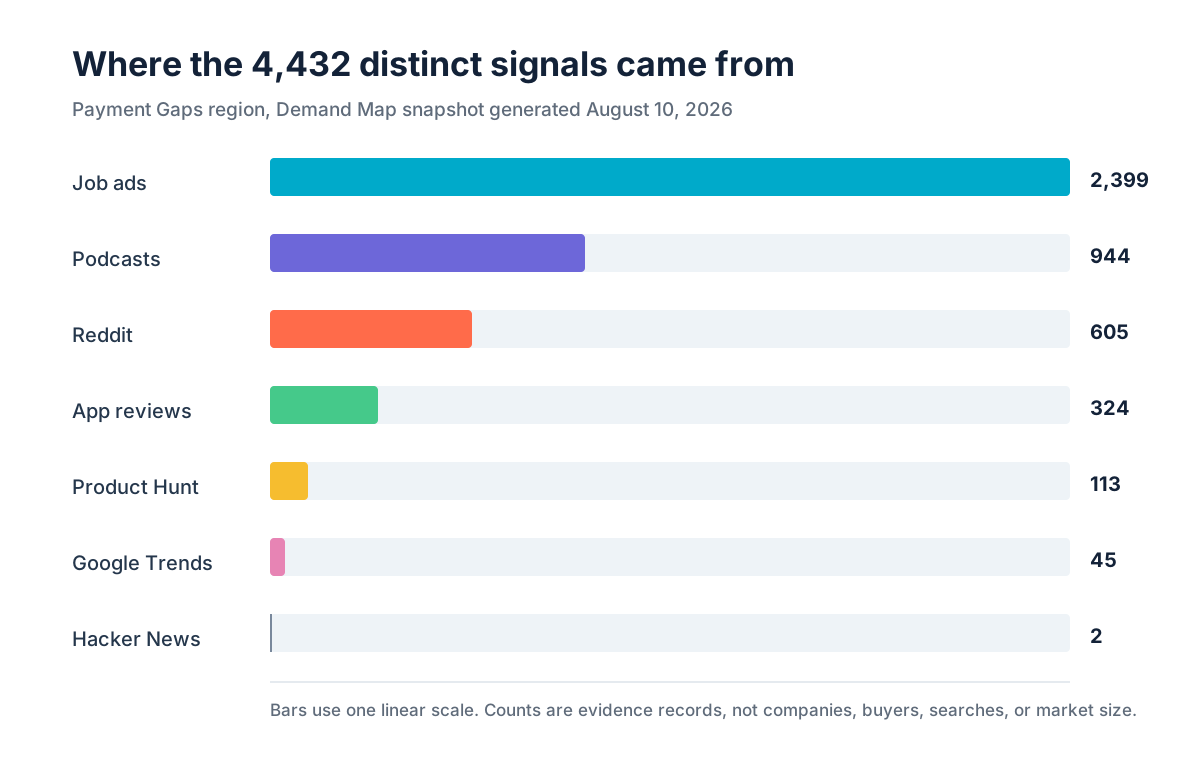
The source mix is more balanced than a job-ad-only story. Job ads are the largest source at 2,399 logical signals, or 54.1%. Podcasts contribute 944, Reddit 605, app reviews 324, Product Hunt 113, Google Trends 45, and Hacker News 2. These sources measure different things. A job ad shows funded internal work; an app review shows a product complaint; Product Hunt often shows supply or competition.
The non-obvious finding: matching is not the finished job
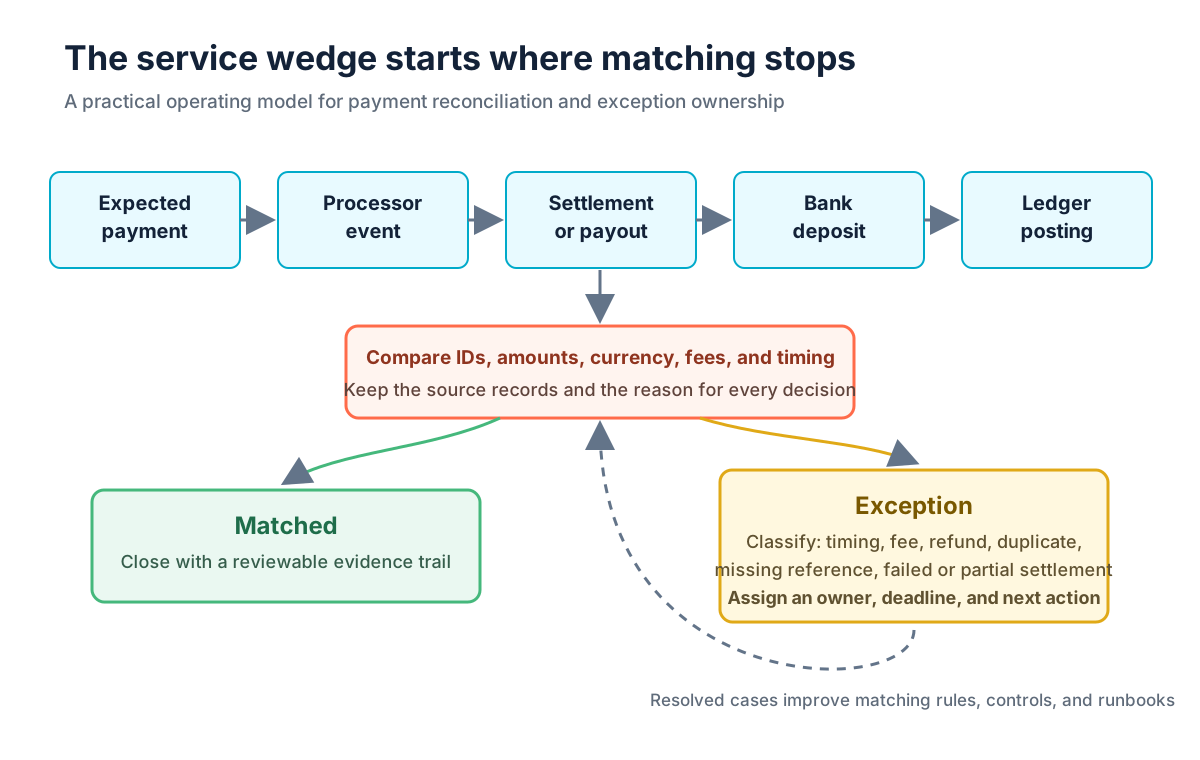
Most product pages lead with automated matching. That is useful, but the hard operating work lives in the remainder. Someone must decide whether an unmatched amount is a timing difference, fee, partial settlement, duplicate, refund, chargeback, reserve, currency conversion, failed payout, missing reference, or a real loss.
Processor documentation exposes the boundary. Stripe's payout reconciliation guide says automatic payouts preserve the connection between a payout and its transactions. It also says users must reconcile instant payouts against transaction history because the platform cannot identify which transactions were included. Tooling can make the records available. It cannot remove every ownership decision.
The workflow below shows why a service can enter before software. A specialist defines the records to compare, keeps the evidence, and gives every exception an owner and next action. Repeated resolutions then become matching rules, controls, or runbook steps.
Three payment reconciliation opportunity patterns
The theme filters overlap and must not be added together. They are transparent lenses over the same 348 ideas.
1. Settlement integrity and exception resolution
One hundred thirty-three ideas match reconciliation, settlement, routing, or orchestration language. The clearest service example is a payment reconciliation reliability service connected to 85 idea-level signal matches. Related ideas include a treasury reconciliation implementation service and a finance data-pipeline reconciliation service.
A practical first offer is a fixed-scope exception audit. Rebuild one payout cycle from expected payment through bank deposit and ledger entry. Deliver a gross-to-net bridge, an exception register, supporting records, and a short list of control or integration fixes. This is easier to buy than an open-ended promise to “automate finance.”
The recurring version is a managed exception desk. It runs daily or weekly, owns aging and evidence, and escalates cases the client must decide. The provider should not post entries, move money, or approve write-offs unless those actions are explicitly authorized and properly controlled.
2. Controls, disputes, and payment-risk operations
Two hundred thirty-three ideas match compliance, KYC?, KYB?, AML?, fraud, chargeback, or risk language. This is the largest theme because reconciliation often supplies the evidence that another team needs to act.
A mismatch can begin as a finance exception and end as a customer-support case, processor dispute, fraud review, or audit request. The service opportunity is the handoff: package the source records, timeline, amount bridge, current status, and decision owner so the case does not restart in every team.
The U.S. Treasury's Bureau of the Fiscal Service lists a dedicated post-payment management layer, including its Payments, Claims and Enhanced Reconciliation system. That does not validate a private service market. It does show that reconciliation, claims, and post-payment controls remain operating functions after a payment system exists.
3. Cross-border and stablecoin operating rails
One hundred thirty-two ideas match cross-border, stablecoin, or crypto language. Examples include a stablecoin payment orchestration API and a payments settlement architecture retrofit service.
The opportunity is not “blockchain reconciliation” as a broad category. It is the additional evidence created when value crosses providers, currencies, legal entities, ledgers, or on-chain and off-chain records. A narrow engagement might reconcile one corridor, payout partner, reserve account, or treasury workflow and document exactly where finality, fees, and accounting treatment are determined.
The Federal Reserve's May 2026 payment-account proposal is one current sign that clearing and settlement access is still changing. The proposal includes limited-purpose accounts and automated controls to prevent overdrafts. It does not prove demand for a startup or endorse any reconciliation model. It does increase the value of documenting which rail, account, control, and settlement record produced an outcome.
Five offers a specialist can test
| Offer | Buyer trigger | Handover | Important limit |
|---|---|---|---|
| Payout exception audit | A settlement or bank deposit does not tie out | Gross-to-net bridge, exceptions, evidence, and next actions | No audit opinion or recovery guarantee |
| Managed exception desk | Recurring breaks age without a clear owner | Queue, aging, owner map, evidence, and resolution log | Client keeps approval and money-movement authority |
| Reconciliation reliability sprint | A fintech has recurring payment incidents or close delays | Source map, matching rules, controls, alerts, and runbook | Does not replace accounting ownership |
| Treasury data implementation | Bank, processor, and ledger records use incompatible formats | Canonical schema, connectors, tests, and review process | Access and retention need a security review |
| Cross-border rail control pack | A new corridor or settlement partner is launching | Flow map, finality rules, fee bridge, exceptions, and evidence plan | Not legal, tax, sanctions, or licensing advice |
Why this matters now
The timing case is operational, not a claim that one keyword is exploding. In Trend Seeker's latest seven-day GSC? window through August 9, 2026, payment reconciliation services produced 19 impressions at an average position of 25, while monitor payment processors produced 23 impressions at 20.96. These are observations about Trend Seeker's own search visibility. They are not public search volume, buyer counts, or evidence of market size.
The rendered worldwide Google Trends helper was checked on August 11 for payment reconciliation services, payment reconciliation software, and payment operations services across five-year and three-month windows. The exact reconciliation phrases had very low regional interest, and the three-month related-query panels returned insufficient data. Other related results were noisy. Google Trends is a relative 0–100 index, not search volume, so this article makes no growth claim from it.
Current search results are crowded with reconciliation platforms and a smaller group of outsourced services. A generic software list would add little. Trend Seeker can contribute a different answer: where the underlying work clusters, which source types support it, and how a founder can test a bounded exception service before committing to a product.
A current direct hiring example supports that boundary. ThinkMarkets' payments and reconciliations analyst role covers daily, weekly, and monthly reconciliation across payment providers, banks, and internal systems, plus investigations with Finance, Compliance, Customer Support, and PSPs?. That proves one company funds the work internally. It does not prove that the company would outsource it.
What the evidence does not prove
The 4,432 logical signals are not 4,432 companies, buyers, jobs, complaints, or searches. The 4,738 idea-signal matches are a separate measure because one signal can connect to several ideas. The 3,173 source URLs? are another measure. None is revenue, transaction volume, or a total addressable market estimate.
Job ads are 54.1% of the evidence. They show that organizations allocate people and budgets to payment work. They do not show which tasks procurement will buy, whether a founder can access the required systems, or whether an outside team can carry the risk.
Public complaints and launch records also need care. A Reddit post about messy Shopify payouts can reveal a workflow worth interviewing around, but it may not represent a buyer with budget. A Product Hunt launch often shows an existing solution, not unmet demand. The right next step is a paid test with one accountable owner.
Payment data carries hard boundaries. A provider may encounter personal data, bank records, card-data obligations, sanctions screening, accounting judgments, audit evidence, contractual confidentiality, or money-transmission rules. Define data access, segregation of duties, approval rights, retention, insurance, incident response, and professional scope before handling live records. Do not promise recovered funds, a clean audit, regulatory approval, or error-free close.
A 30-day validation plan
- Choose one payment path. Pick one processor, payout type, bank account, entity, and ledger. Avoid a multi-rail transformation as the first engagement.
- Collect ten closed exceptions. Ask what failed to match, how long it aged, who resolved it, which evidence was missing, and whether it returned.
- Sell a fixed exception audit. Define the period, records, matching basis, access method, deliverables, exclusions, and decision owner before receiving data.
- Measure the operating result. Track exception age, repeat rate, amount at risk, manual touches, unsupported adjustments, and close delay. Do not invent savings from transaction counts alone.
- Automate the repeated rule. Build an importer, matcher, evidence pack, alert, or queue only after several paid reviews expose the same step.
Compare this wedge with live FinTech, Security, and Personal Finance business ideas. The job-ad signal guide explains what hiring evidence can and cannot prove. The evidence-score guide explains why multiple independent sources matter, and the startup validation guide covers the next buyer test.
Methodology
This analysis uses Demand Map version e27439ab-37af-485d-86dd-235c8e00b31a, generated at 23:30 UTC on August 10, 2026, with source data through 00:00 UTC on August 11. It includes all 348 ideas assigned to region 10, Payment Gaps.
A distinct logical signal is deduplicated by the pair of source kind and logical signal key. An idea-signal match is one connection between an idea and a signal. A distinct source URL? is one public evidence location among deduplicated records that include a URL?. Freshness windows end at the snapshot generation time. These measures are related but not interchangeable.
The three themes use overlapping text filters over idea titles, taglines, problem summaries, and categories. Settlement integrity matches reconciliation, settlement, routing, or orchestration language and contains 133 ideas. Controls and risk matches compliance, KYC?, KYB?, AML?, fraud, chargeback, or risk language and contains 233. Cross-border rails matches cross-border, stablecoin, or crypto language and contains 132. Because an idea can match several themes, the counts must not be summed.
We reviewed the highest-signal ideas, representative public records, current Trend Seeker pages, the latest seven-day GSC? query window, rendered worldwide Google Trends results, current search results, competing services, and the primary sources below. GSC? impressions and Google Trends indices were used only as intent context. They were not counted as Demand Map signals or public search volume.
Sources and further reading
- Stripe: payout reconciliation report
- U.S. Treasury: post-payment management systems
- Federal Reserve: 2026 payment-account proposal
- ThinkMarkets: payments and reconciliations analyst
- PayoutClarity: current example of a scoped payment-exception service
- Product Hunt: public request for a reconciliation view
- Trend Seeker: current Payment Gaps Demand Map
Ready to find your next business idea?
Explore validated business ideas backed by real user demand.